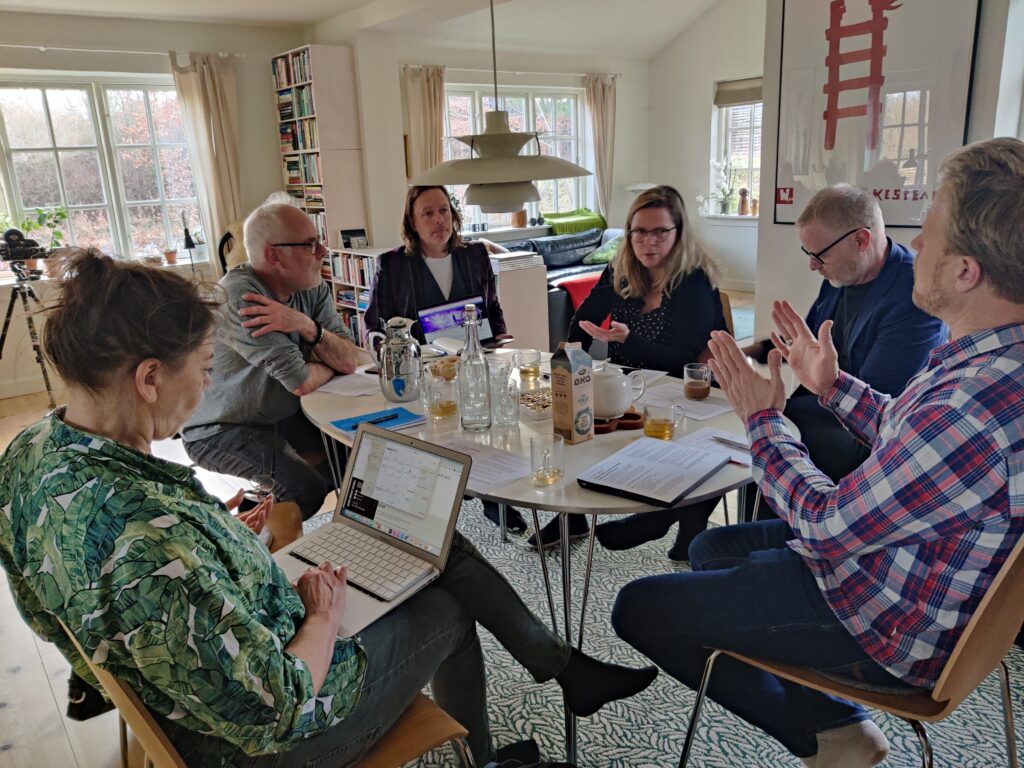

On Thursday, September 22, 2022, we held our general assembly at Spar Nord. It's a formal event, of course, but on this occasion, the board also marked the association's 1-year anniversary with this report, which, by the way, was approved by the assembly. Plus, we treated everyone who came to cakes from Bagt:
by Chairperson Aslak Gottlieb
When the newly elected board met a year ago, we set ourselves the task of building as much capacity in the association as possible through volunteer work and networking. This report is all about how that went.
In plain numbers, you could sum up our capacity like this:
That gives us an income base of 59,000 kroner. Supplemented by grants from Spar Nord Fonden and Nordea Fonden totaling 75,000 kroner, we've managed to generate a total income of 134,000 kroner. I'll get back to how we've managed to turn those membership fees into activities.
Another way to measure our success is by looking at how well we've managed to communicate our messages. We've achieved:
- 16 press mentions
- 200 followers on LinkedIn
- 250 followers on Facebook
- 100 newsletter subscribers
As an association, it's naturally important that people also participate in our activities. If we add up our meeting and workshop activities, we're close to 100 citizens – mostly locals of all ages – who have engaged with us by physically participating in our work in one way or another. We hope this number will multiply at Culture Night in Helsingør on 30/9. In collaboration with our member companies, we've planned five events with great names and varied content, which we have high hopes for.
On this occasion, the board will hit the streets to recruit private members for the association or receive donations through one-on-one conversations. That was one of the pieces of advice our advisory board gave us earlier this year: Create more activities, lower the membership fee, and get more members to legitimize the project.
At this general assembly, the board is also proposing an amendment to the bylaws so that the membership fee for private individuals will be reduced from 300 to 100 kroner annually.
But capacity shouldn't just be measured in numbers. Our activities, after all, happen between people and are typically based on experiences and conversations that can't be quantified. Cultural activities could be described as gatherings around a shared third element; for example, music, food, art, conversation, literature, or storytelling.
Speaking of storytelling, the board has worked thoroughly on a core narrative. This outlines the fundamental ideas and values that we believe are the essence of Helsingør as European Capital of Culture in 2032. The work has been inspired by our activities, such as the creative future journeys we took two 5th-grade classes from Espergærde on in the old theater hall in Stengade, or the walking workshop we held for members and interested citizens at Hamlet Scenen.
The core narrative is formulated in a piece of prose that has been published on the website. In bullet points, it culminates in some goals for the project, but it doesn't constitute a strategy as such. Because we still have a fair amount of time to formulate our application to the EU, the board has prioritized building the association's capacity before working on formulating a strategy. This will be the most important task for the upcoming board, as soon as they've convened and, by the way, wrapped up the Culture Night events.
I'm personally looking forward to the strategy work. Not that it will be an easy task, in that sense. On the other hand, it will be rewarding for two reasons. I've just touched on the first one: We've clarified our core narrative and built up a good capacity. The second reason is provided by the EU. In their guide for writing the application to become a European Capital of Culture, six points are listed that the applicant city must address. So, there's a fixed framework within which we can be creative.
By the way, the six categories that carry equal weight in the application are:
- Contribution to the long-term cultural strategy in the area
- Inclusion of the European dimension
- Cultural and artistic content
- Capacity to deliver
- Communication and engagement
- Leadership and administration
For our strategy, we're getting advice from our advisory board. We're also talking with representatives from the EU system and other Capitals of Culture or candidates for the title. It's worth noting that our discussions with Helsingør Municipality are informal right now. We need to figure out when and how to formalize them over the next year.
Next year, we're also hoping to hire a part-time project employee. This was actually planned for 2022, but the board quickly realized the financial commitment was too big. The profile of this person will be an important strategic choice. Should we hire a curator? A communicator? A fundraiser? The association's administration is already supported on a voluntary basis with a very professional touch by Susanne Estrup, who is a deputy member of the board and the only one mentioned by name in this report.
The list of dedicated people who have contributed to the project throughout the year is really long! If you check out our website (which, by the way, was developed pro bono by one of our member companies), it becomes clear that many people have been involved in the project even in the association's first year.
The snowball is formed. Now we need to get it rolling!