
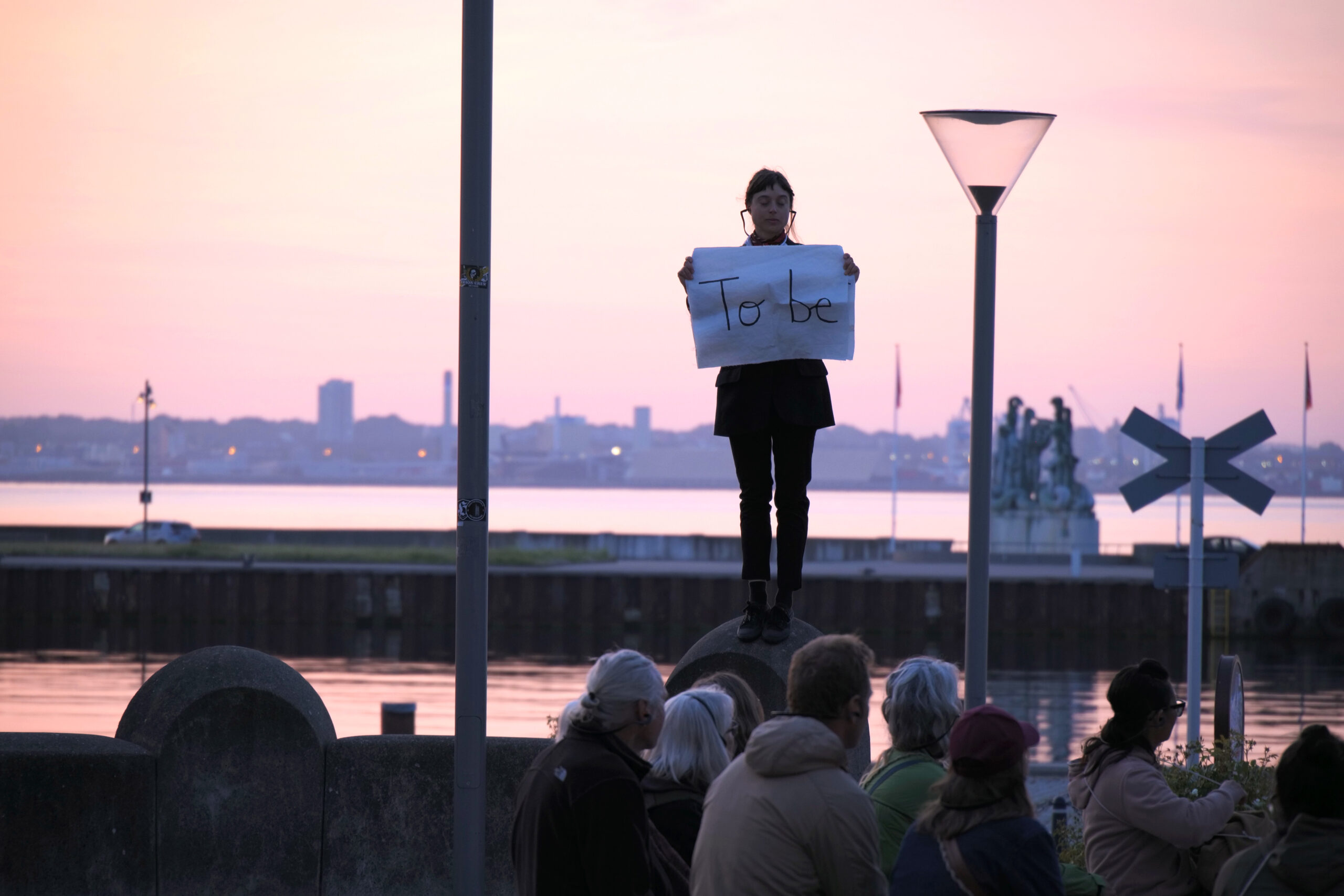
Photographer: Caroline Perjes. “From the performance ‘Porøs’ by Darya Efrat (DE/IL) + Mathilde Roy (FR) at the Passage Festival 2024.”
Two words. “To be.” With a touch of irony, we dismiss the possibility of “not to be” in the iconic line that Shakespeare presented to audiences 400 years ago in the all-time blockbuster drama, *Hamlet*.
We are now borrowing these two words as the title of our bid to become the European Capital of Culture in 2032, because the question of our place in today’s Europe has only become more complex and challenging since they were written.
Given the brevity of the title, it seems almost ironic that the list of contributors to our candidacy is so long. Yet the prequalification application must not exceed 60 pages. Our goal is to concoct a strong and flavorful bouillon cube.
The association is developing the application in collaboration with the City of Helsingør, which is applying for the title. The collaboration began in March, when 22 city council members decided to pursue the title. The deadline is October 5, when we will personally deliver the printed “bid book” to the Ministry of Culture.
So, here’s a mid-term thank-you from the association’s secretariat to:
- More than 300 citizens attended our discussion events—for example, at the Hornbæk IF Clubhouse, at the Day of Associations at Axeltorv, at a community dinner at Kulturhus Nordvest, and with the audience of Helsingør Theater after a performance at Kulturværftet …
- More than 60 respondents in a questionnaire survey from the cultural and business sectors throughout North Zealand and Skåne
- 30 participants in two creative workshops facilitated by the think tank 21 Europe
- 25 city council members who have been actively involved in the process during two thematic meetings
- 11 political committees, councils, and boards in the City of Helsingør, all of which have discussed the potential impact of the candidacy on their areas of responsibility and provided us with feedback
- 10 local project partners who are participating in workshops and developing the cultural program for the application: HamletScenen, Helsingør Municipal Libraries, Helsingør Theater, International People’s College, Kulturværftet, Kronborg, Museum Helsingør, M/S Maritime Museum, Ungdomsskolen, and the Øresund Aquarium
- 8 active board members in the association
- 3 employees at Helsingør Municipality’s Center for Culture and Business (and colleagues from other departments!)
- 3 European consultants specializing in applications for the title of European Capital of Culture
- 2 specialists from the Institute for Cultural Analysis
- 1 maritime museum (M/S), which provides space and capacity for the secretariat
- 1 ad hoc team from Wonderful Copenhagen
- All of the association's many dedicated members
The work on the bid has branched out into a network that is constantly growing. We receive many qualified inquiries, and far more people than those mentioned on the list are contributing to the process, which began way back in 2017, when Aarhus held the title.
Here is a selection of highlights that have helped the project mature:
2022: 250 schoolchildren give the collective dream for the future a shot in the arm