

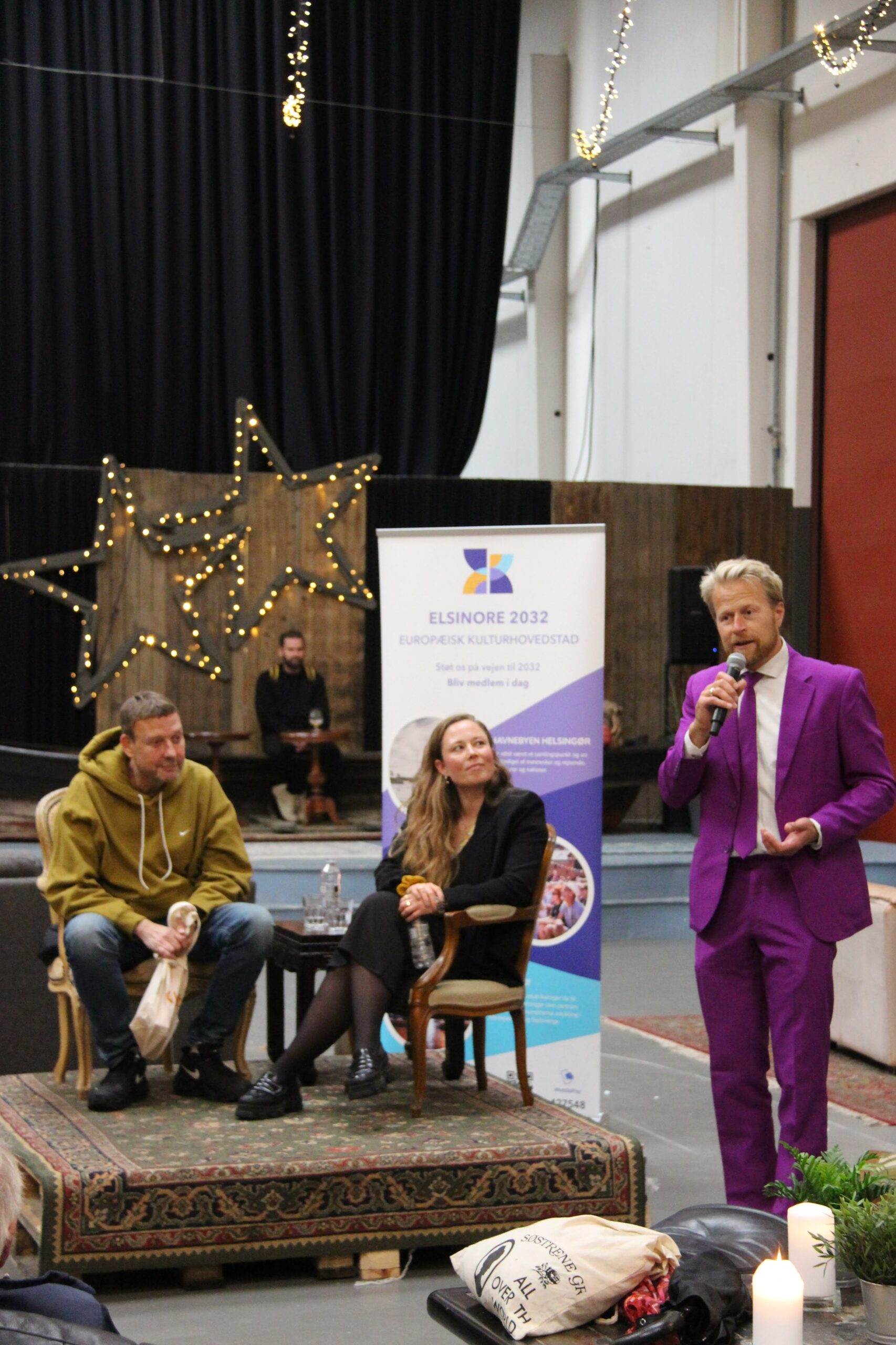
With a vote of 20-5, a majority in the Helsingør Municipality council decided last night that 10 million kroner for an application to become European Capital of Culture in 2032 should be put on the wish list for the autumn budget negotiations. Aslak Gottlieb, Chairman of Elsinore 2032, provides an update.
This is the second time this year that the Capital of Culture project has been officially discussed as a political matter in Helsingør Municipality. Both times, a good majority has moved the ball forward. When it's discussed for the third time this autumn, it will be in the final round that decides the vision's future. Naturally, we in the association are very excited about this.
To be able to participate in the competition to become European Capital of Culture, the local city council must contribute to the application and document that the project is part of a long-term cultural strategy. That's why we at Elsinore 2032 couldn't carry out the project alone. It was never meant to be, anyway.
The association's statement of purpose says that the association's work consists of a forward-looking, focused effort that, by 2026 at the latest, must result in a political decision to apply for the title, and that a formalized partnership between businesses, the municipality, associations, and cultural institutions must be formed beforehand.
When it's hopefully finally decided this autumn that there will be room in the budget for this visionary investment in culture, the association will have achieved that part of its purpose. Then we can continue our work with renewed energy, contributing to realizing the vision.
The partnership between businesses, associations, and cultural institutions has already been realized through memberships. The partnership with the municipality was established in the collaboration on the preliminary study, which forms the basis for the city council's political handling of the matter. The association has contributed financially to the study and participated in its steering committee.
This somewhat dry statement of affairs might seem both technocratic and self-absorbed. As an association, we've just won an important battle and qualified for the final round. Time for toasts and cheers! But if we're still holding back a bit, it's because since the association was founded in 2021, we've already been working hard. Not just through our activities, but also in words and speech, for example, as expressed in our core narrative.
When a smaller city like Helsingør hopes to earn such a grand title as European Capital of Culture, the dream is rooted in the city's strong historical self-awareness and the local community's ability over centuries to embrace its inherent contradictions: aristocracy and working class. Market town and suburb. Local and international. Danish and multi-ethnic. Provincial and cosmopolitan. Elite and popular.
From the association's core narrative.
The whole point of revisiting these paragraphs is that the European Capital of Culture project will never be a success if we, as an association, can't let go of the ball and let it be played around. It's our association's most important task to make sure the project opens up and includes as many qualified players as possible.
The strong majority in the city council to invest in the application speaks for itself, of course. That being said, it's important that we use public discussion to refine the project. This includes our politicians fully committing to the cause by stating what results they hope to see from the project.
Theatre director Jens Frimann sends this clear appeal in Lokalavisen Nordsjælland:
Politicians, speak up and tell us where you stand. What's your vision? Don't wait for reports and bureaucracy. That only leads to decline and cutbacks. Commit to the City of Culture (the European Capital of Culture project, ed.) or kill it once and for all. If you commit to the vision, you need to put your administration (and all of us others) to work finding funding. It's precisely these big, ambitious projects that foundations and others are keen to invest in. Helsingør has a huge advantage here thanks to its maritime history, its cultural heritage, and its vibrant cultural life.
Jens Frimann Hansen, head of Helsingør Theatre. Lokalavisen Nordsjælland, June 19, 2024
The municipal administration seems to agree with the theatre director's observations. In their comments on the political case presentation at the city council meeting on Monday, June 24, they write, among other things:
The title of European Capital of Culture is also a very big and resource-intensive task. Therefore, it's crucial to have broad political support for any potential decision, and to be ready to prioritize the task across the municipality and make the necessary investments. If the City Council wants to go for it, they need to do it wholeheartedly.
Excerpt from comments to Helsingør City Council from the staff in culture, business, and tourism
As an association, we're getting a head start on the fun and are busy organizing Culture Night for September. It's a huge volunteer effort that used to be handled professionally, actually by Helsingør Theatre itself. This year, the preparations will be even more forward-looking because, at the same time, we need to have conversations about what direction Helsingør should take as a Capital of Culture.
Aiming high and collaborating widely is the association's overall strategy. We're not here for ourselves. We're here for cultural players and everyone who benefits from it – citizens, associations, the municipality, and businesses. That's why it's important to emphasize these paragraphs, which remind us why we exist.
It's a good investment, not just financially, but also in terms of soft values.
Michael Mathiesen (K), chairman of the Culture and Tourism Committee.
